
Don't hate the media, become the media. Jello Biafra
THE BBC'S FIRST HOMOSEXUAL
THE BBC'S FIRST HOMOSEXUAL
Writer: Stephen M Hornby
Director: Oli Hurst
Cast: Mitchell Wilson, Max Lohan, Andrew Pollard
UK Tour | February 2026
17-18: The Hope Street Theatre,
24-25: Loughborough University
Images © Kelsea Knox
FEB, 12, 2026

Breathe. I keep telling myself to breathe as I try to begin this review. Now that time has allowed the themes, stories, and histories to settle, I’ve become somewhat unsure how to start for fear of offending someone within the LGBTQIA+ community. The political bedrock that Dr Stephen M. Hornby’s new play is built on is thoughtfully urgent and at times frustratingly sad. The expansion of the LGBTQIA+ community has inevitably led to the fragmentation of the political nexus that was always tentatively held together. This has been further hindered by groups within the community that no longer consider themselves part of the movement. The safe spaces that allowed a sense of freedom, camaraderie, and connection have been replaced by gentrified villages and apps. This has weakened the political clout that the community once had, enabling politicians to offer platitudes and soft soap to convince the community they’re on our side. The BBC’s First Homosexual is a battle cry that doesn’t make its audience angry at the past but rather offers a deeply meaningful narrative that leads to a long overdue conversation.
The biggest problem contemporary theatre has when creating a historical production is trying to view the past with modern eyes. It’s neither fair for the story nor for the potential message the writer is aiming to convey. It’s a balance that’s so fine it’s near impossible to get it right. Hornby, with historical advisor Marcus Collins, has navigated this with such aplomb that it has allowed The BBC’s First Homosexual to feel like a time capsule. Hornby avoids making the audience annoyed at any of the characters, even Mary Whitehouse; instead, he allows the past to be the past. And he has achieved this through emotional rich dialogue and gentle humour. Which means the audience becomes fully immersed in the stories, forging a connection that provides us with a new, powerful understanding of a past that has been slowly disappearing from the discourse in LGBTQIA+ communities.
By introducing the fictional Tom, Mitchell Wilson, into the narrative, Hornby anchors his text with a sense of duty by providing a voice to these ghosts of the past. It’s through Tom that the audience feels the gravity of the situation, the pain, anguish, confusion, and longing. Tom is an amalgamation of these hundreds of thousands of young men eager to discover their lives whilst struggling to conform to society's moral expectations.
The 1950s was a transformative decade. It was in the 1950s that the teenager really started to come into their own, a new demographic of young people who, until recently, had been alien to the wider social order, perhaps marking the beginning of Britain’s first existential crisis. Films like Rebel Without a Cause (1955) and the emergence of the Teddy Boys, or the Teds, in the 1950s cemented the decade's rapid social changes, which would have lasting impacts on society. Any change to the prescribed social order is always met with fear, scaremongering, and demonisation. The preteens of the war years were now functioning adults caught between toeing the line set by the generation before them and realising a new freedom that postwar Britain offered them.
In any conversation about LGBTQIA+ history, the impact of WW2 and the experiences of soldiers during the war years can’t be downplayed. As Europe was liberated, the freedoms, expressions, and experiences of men during this time would have been profound. As the war started to come to a close, the first pangs of fear and trepidation would start to set in as men made their way back home. Awaiting them would be their preplanned lives of marriage, family, and work. War offered a shield of sorts that allowed for feelings and connections to flourish with some security. WW2 wasn’t a busman’s holiday by any stretch of the imagination, but heading home would be as rude an awakening as it was for the Land Girls. The liberation that the Land Girls enjoyed during the war years was equally to come to an end as soon as men returned to ‘reclaim’ their place in the workforce and society, women now expected to return to being wives, mothers, and housekeepers; this was the order of things. It’s through this intertwining narrative that Hornby unpacks a deeply rich history that connects to the origins of homosexual identity and liberation, and it starts with Tom.

Tom, a 19-year-old Mancunian gentleman’s outfitter, comes to the stage in his crisp suit that is perfectly tailored but gives the slightest impression that it’s a little too big for him. He has a broad, somewhat cheeky smile. There’s something inane in the gossip he shares about the promotion happening in his store, and yet within a few minutes, Wilson has you utterly captivated by Tom. This is the first opportunity Hornby takes to give the audience a sense of the world that his story inhabits, this youthful energy that’s spiked with a polite foreboding. Though Tom is a fictional character, his experiences are all too real, and we know what his outcome would likely be. And yet in these moments we get to share with him, he paints a life that is rich and filled with a strange optimism. As he talks about his job and his family, faint cracks begin to appear as he finds himself under increasing pressure. First, there’s Anthony, Max Lohan’s, a work colleague he idolises who gets arrest for cottaging, then there’s the succession of young, available ladies his parents have lined up for him. Emotionally, Tom is being pulled from pillar to post with no external relief or support. He knows who he is, or what he is, and it’s the social impact of his realisation that weighs heaviest on his mind.
Of all the stories Tom shares, it’s the one about going to a boxing match with his ‘Pa’, Andrew Pollard, that was to me at least, one of the most touching. Tom is young but is considered a man. This trip to the boxing match is a bonding moment between father and son, but without the emotional attachment – that’s the English way, right? Pa’s generation simply didn’t talk about certain things; for them, marriage was a contract that allowed men to have sex and women to leave one master for another; if love happened, then all the better. His father isn’t cold; it’s just not in him to be able to have the type of conversation Tom needs to have when he’s ready to have it. In this same space, two generations coexist with a chasm between them. Tom’s generation is ready to take control, evolve, and break free of the constraints that his pa’s generation has been tethered by.
Through the backroom shenanigans of two BBC executives who are trying to make a radio documentary about homosexuals, Hornby inter-splices Tom’s story, highlighting how salient this documentary was really going to be. There were three tenets of British society: the monarchy, the political, and medical. For 1950s Britain, these three groups dominated British social life, and yet, empowered by the role radio played in the war years, the BBC established a new tenant: media. Public debate on issues that impact society is usually, in our modern media landscape, dominated by big personalities. Few people will remember Mary Whitehouse or the impact she had on the discourse, but it was great, and the wireless became her greatest tool for reaching the masses, far greater than newspapers or newsreels. As the public began to loosen the shackles placed on them by the political and medical class, the media, first print, then radio, and lately TV, wonderfully illustrated towards the end by Lohan and Pollard, would fill the void.
The task set by the BBC executives was great, and Hornby instantly highlights the weight of what they’re planning. The age difference between the BBC executives is quite telling, as they represent the changing landscape of a postwar Britain, as younger and likely inexperienced voices gained opportunities to shape the public opinion in ways never thought of before. Pollard’s seasoned BBC executive, is eager and willing to champion the programme, but he has a lot of skin in the game and knows how the BBC works; this is contrasted by Lohan’s younger and at times impatient BBC executive. This wouldn’t just be a radio broadcast; this would be legitimacy for homosexuals, a word both executives mumbled under their breath initially. It’s important to note that being a homosexual or being accused of homosexuality, at this time, was considered having a mental illness. This is vital because throughout modern history male same-sex relationships have always been vilified and criminalised by the establishment; the same isn’t true for female same-sex relationships, which have never been a criminal offence in the United Kingdom. Self-identifying as a homosexual was to admit to society's prescription of you being abnormal. This was set in law, culture, society, and the medical profession.
For these two BBC executives, the Wolfenden Report (1957) was the catalyst for finally broadcasting their now heavily edited radio documentary. As important as this was, and I may be a little cynical, one could make the argument that the only reason why this report was commissioned was because of the notable men being charged with homosexual offences. The unavoidable public attention of these arrests meant the state was now more willing to make recommendations because they themselves became affected by the issues. Homosexuality has existed within the establishment for hundreds of years (see the Cleveland Street Scandal), but with the increased media attention and changing cultural and social norms, these lives couldn’t remain hidden any longer. Rather than focus on the big names in this scandal, Hornby provides us with Anthony. Though we only meet Anthony once, his presence lingers for the remainder of the play. You’re left wondering about his life after the arrest, how someone who wasn’t noble or a celebrity would traverse their public shame.
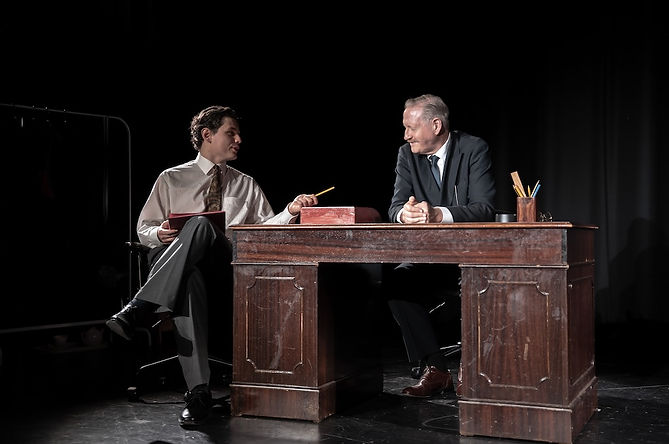
Each time Wilson comes to the stage, he unpacks a new strand of Tom's life, injecting something so genuine into his character that he leaves you with your heart in your hand on more than one occasion. One such scene comes during a night Tom finds himself being drawn to the toilets, the same toilets Anthony had been arrested in. By this point, Hornby, director Oli Hurst, and Wilson have made the audience so endeared to Tom that under my breath I could hear myself mumbling, ‘Don’t do it.’ The scene is a masterclass of subtle, measured theatre. As Tom makes his way towards the toilets, you feel the powerlessness that the place has. The seedy, dangerous, vulgar space is the only real refuge he has. Hornby expands this to exploring more homosexual spaces, in backrooms of hotels and pubs in London that, even though illegal, provided the only opportunity for men like Tom to feel safe, be seen, and be themselves. What we would call Queer Spaces offered a lifeline for the community; they allowed for them to be free, to find a common ground that allowed the negative noise to be shut out from the outside world. Moreover, these spaces became sacred ground that for decades shone like beacons to runaways, closet cases, and the isolated. Now visiting London on the regular, Tom’s confidence and sense of himself has grown. Each time he talks about his visits to London, to Soho, a different person seems to be presented; in finding his tribe, he’s been able to quieten the noise.
This all comes to a head for Tom when he meets Jack. Every word Wilson speaks about Tom’s relationship seems to come from a place so meaningful and so full of love. These aren’t just Tom’s words; these are words of hundreds of men who thought they could never love, be loved, or be free, and Wilson makes you feel every word. As Wilson pulls his hand away from Lohan’s deep inside of you, you know that this is the right thing to do; the life of lies, subterfuge, and fear isn’t a life. But it was a life that thousands of men chose; some managed to outlive the fear and find their happiness, others didn’t, couldn’t. Like many of these scenes, Hornby somehow manages to never get you angry, but he makes you feel an emotion. This is as close as Hornby gets to blurring the contemporary and historical narratives. It’s a heartbreaking moment played with such delicate beauty by Wilson and Lohan; your heart truly sinks.
Hornby leaves Tom with very little choice by the end, and one can’t blame him. There was no community back then that had power, position, or the ability to have its voice heard. Homosexuals were deemed sick. Watching Tom share his experiences, one can only imagine the internal pain he was facing and the stories he was reading about in the press as the increase in homosexual arrests persisted throughout the 1950s. I thought it was curious that the playwright chose Manchester for the fictional Tom, the city where Alan Turing died. Newspaper reports of the day show a generation of young men who had no choice; if they submit to their illness, their only outcome was death.
Leaving The Cinema Museum, I feel a sense of pride when I really shouldn’t. Hornby and Hurst have crafted a play that masterfully empowers their audiences to take a moment and think about what they’re not doing. The simplicity of this production is a throwback to the theatre of a bygone era, where productions not only had an important message but were also told in a way that stripped them of all the bells and whistles that can make theatre overbearing and clunky. Patch Middleton’s sound design and Matthew Hodgkiss’s lighting – with blue hues buffering scenes – give the production focus and complement the multiple scene and character changes, never feeling intrusive. With a change of a hat, wig, scarf, cap, or glasses, Lohan and Pollard morph into a variety of characters with an ease that always affords their characters substance, even if they’re only fleeting. The care they take to bring these characters can only come from actors who have truly connected to the text and have been willing to be fully guided by their director.
"... but with the continued attacks on the trans community, lack of legislation on conversion therapy, and a growing trend of homophobic attacks, we should be more active."
I wonder about Tom, reading that story in the paper that exposed Anthony, and I imagine him reading about Alan Turing. Having your desires deemed immoral and inhuman, and being left with either chemical castration or prison as your only options, with social outcasting also an inevitable outcome.
How much did this fear impact the lives of young men like Tom? The first Pride march in the UK took place in 1972. Terry Higgins was one of the first gay men to die from AIDS-related pneumonia 10 years later in 1982. By 1988, the Thatcher-led government passed Section 28, a policy that would be repealed in 2003. What has happened to the community? Why are we not as political or vocal as we once were? The fight that we have now might be different; the community has more rights than it had 20 years ago, but with the continued attacks on the trans community, lack of legislation on conversion therapy, and a growing trend of homophobic attacks, we should be more active. The attacks on the community, be it drag story time or access to trans information/treatment, are usually front-page news. Everyone has an opinion on it, and much like those old voices in the past, the negative voices get more platform. And yet when it comes to saving children and young people, there is a deafening silence when it comes to conversion therapy. The silence is loudest from elements of the LGBTQIA+ community and our allies, because of our indifference to the subject. Every now and then, a news story or a cis-focused story arc might appear on one of the soaps, but that is it. The damage that this type of rhetoric has and the long-term effects it places on the community are irreversible. We’ve become somewhat apathetic, disenfranchised from the movement, and unwilling to get involved, and I am no different.
There’s a weight to this production that I don’t think I was really ready for. Watching Lohan, Wilson, and Pollard take their bows in the vast hall of the Cinema Museum, you could feel the enormity of it all as Lohan gently patted Wilson on the back as they accepted the applause from a grateful audience, tears in his eyes. It’s a touching moment that allows you to appreciate the skills Lohan, Wilson, and Pollard have brought to their characters as well as the authenticity of their portrayal. They let you feel their connection as a small company and present a production that is peerless, leaving this as one of the most important new pieces in British theatre of 2026.